Three Books on a Table

When this novel began, there were three physical books on my table, and none of them had anything to do with the others. One was a slim green-and-gilt volume from 1922 called The Wild Heart, eleven animal sketches of Puget Sound country, foxed at the corners, written by a woman almost nobody remembers. One was the Theogony of Hesiod, a genealogy in verse, roughly a thousand lines of who was born to whom, composed by a Boeotian farmer about seven hundred years before Christ. And one was the Inferno, in the English that Henry Wadsworth Longfellow made out of the worst years of his life. An animal book, a family tree, and a tour of hell. The Disposition is what happened when I stopped treating them as three books and started treating them as one instrument with three registers.

Continue reading → Three Books on a Table

The Magnificent Loser: The Book I Wrote to Answer Two Words in Red Ink

Every writer carries a verdict he never agreed to. Mine was two words long, written in red marker across the title page of a play I cared about, by a historian whose judgment I had asked for and could not afford to ignore. BAD DRAMA. No note beneath it, no argument, no second page. I was in my twenties. I put the play in a drawer and told myself I had learned something useful about my own limits. It took me forty years to understand that I had learned the wrong lesson, and that the right one would take an entire book to say.

Continue reading → The Magnificent Loser: The Book I Wrote to Answer Two Words in Red Ink

The Station Across Town: A Lincoln Boyhood, the Federation I Did Not Watch, and the Second Half of a Television Diptych

When I was sixteen, I had a television show called Kidding Around on KOLN/KGIN-TV in Lincoln, Nebraska. It was 1981. I was a teenager hosting a teenager-aimed program on a commercial CBS affiliate, three blocks of which I have no doubt were paid for by advertising for Pepsi and Levi’s and the Lincoln car dealerships that kept American local television alive in the early Reagan years. The format was loose. The show featured kid interviews, viewer letters read on air, and unscripted segments of the kind that the FCC’s mandates for “ascertainment of community needs” were supposed to encourage and that the FCC’s 1981 decision to deregulate radio, followed by the parallel television deregulation of 1984, was designed to kill. Kidding Around did not survive into the late 1980s. It was a casualty of a specific federal policy decision documented in the book I published earlier this year, Selling Saturday Morning.

Continue reading → The Station Across Town: A Lincoln Boyhood, the Federation I Did Not Watch, and the Second Half of a Television Diptych

David Boles’ Personal History: December 13, 1994

A career is an interesting thing in comparison with a life. The career is temporary, but the life is both temporal, and temporary. The other day, for some reason, Ezra Stone was bothering my mind, as I tried to remember why he had contacted me so many years ago. I did a quick search of my Google Docs and his name popped up in a document titled — “David Boles’ Personal History” — dated December 13, 1994. That file turned out to be a wowser!

I am not sure why that document was originally written. I was three years out of my MFA at Columbia University in the City of New York. Oftentimes, these personal histories are written for grants, but this file was too personal, and specific for a grant committee — the file reads as if I were forcing myself to remember what happened for some existential reason.

One thing I noticed about the file is that it is filled with names — and that still astonishes me, that so much effort and time for what I was trying to do was not really ever about the actual work, but it was more about the personalities involved. I’m an INTJ, not really a people person, so it makes sense I had more ongoing success working alone in Nebraska than I ever did working with the creative gangs in New York City. On your own, you’re on your own to live or die; I always thrived. In the City, you a play a limited role by design, and you have to hope others are as dedicated to you, and to your idea, as you are — but it never turns out that way.

Nobody wants to pay for anything; they want every idea for free; and you always hope it’s about the work — but as you’ll see — it’s never about the work. It’s only about — the money!

This document may have been a tipping point or a turning point — two years later I started Go Inside Magazine — and began writing and publishing on my own. I could serve only the Master I knew, and no longer the talents I did not understand.

Continue reading → David Boles’ Personal History: December 13, 1994

An Unredeemable Removal: William Jennings Bryan as the Magnificent Loser

William Jennings Bryan — known as “The Great Commoner” and “Keeper of the Faith” — was a Populist, religious, conundrum. He was for the people. He was against big money. He fought, testified, and prosecuted via the Bible — in utter infamy — during the 1925 Scopes Monkey Trial and died five days after the trial ended. Defending his Faith killed him.

William Jennings Bryan was a good son of Nebraska who was nominated three times on the national Democrat ticket — and he lost each time — and his failure to find a national political footing beyond his deeply religious Nebraska grassroots haunted him until his death.

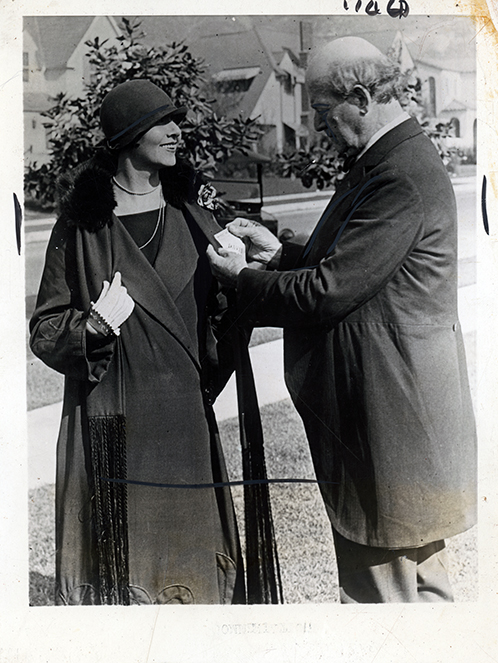
I was able to purchase this fascinating photo of William Jennings Bryan, dated September 18, 1924 — he would be dead 10 months later — the caption reads:

WITH THE COMMENDATION OF THE COMMONER

Photo shows William Jennings Bryan pinning a badge of allegiance (David-Bryan campaign stuff) to Rose Minto’s coat lapel. She is a popular motion picture star in Hollywood who is actively interested in politics.

What is most interesting about the photograph is the use of the black editorial pen on the image.  You can see the crop indices, but there are also black ink pen “lines of emphasis” added to Ms. Minto’s hat, Bryan’s lapels and face. You can see the dullness the pen makes when you move the glossy photograph in your hand in and out of reflective light.

At first wink, those added lines look like marks of defamation until you realize, after scanning the photograph for publication here, they must have been an important part of newspaper publishing in 1924 to help the highlights and shadows be more discernable in ink on paper.

Continue reading → An Unredeemable Removal: William Jennings Bryan as the Magnificent Loser

The Bridge Generation Between the Paper Mountain and the Uncanny Valley

As we descend deeper and deeper into The Uncanny Valley, we are left to wonder if we want those built to be like us, to be like us, or if we prefer them to look mechanical so we can more immediately identify not just what, but who, we are interacting with in our intimate lives.

Continue reading → The Bridge Generation Between the Paper Mountain and the Uncanny Valley

Alert to All Stations From U.S. Marshall, Florida

[Publisher’s Note:  The last Marshall Jamison poem we published here in Boles Blogs was — Paul’s Wife — on June 15, 2000.  Marshall died  September 2, 2003 at the age of 85.  We still massively miss him.  Boles Blogs author Steve Gaines — who worked with Marshall in educational television in Nebraska — recently found the following poem Marshall wrote to celebrate Steve’s retirement from the network.  Steve was kind enough to email us Marshall’s original, handwritten, poem — which we are overjoyed to present to you today:  The first new Marshall Jamison poem published here in 13 years; and a decade after his death.]

Continue reading → Alert to All Stations From U.S. Marshall, Florida