Arm in Arm with Chance

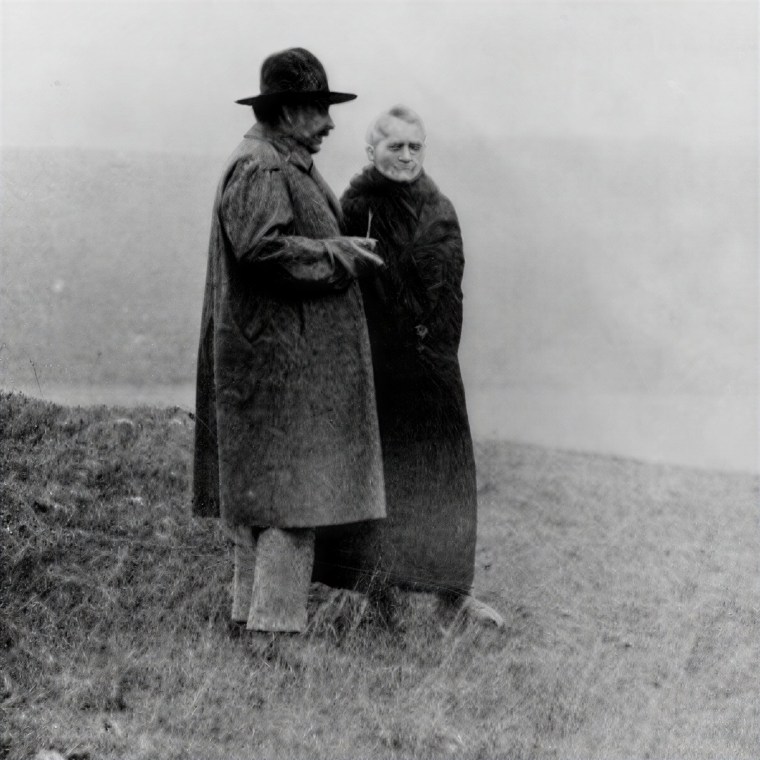
A misdated photograph, two of the largest minds of the last century, and the partnership physics never got. The photograph travels well. A man and a woman walk the edge of a lake, both buttoned into heavy coats against a cold the season should not have brought. He wears the famous hair, gray now at the temples, the drooping mustache, the look of someone who long ago stopped negotiating with his tailor. She is smaller and upright, her face composed into the expression of a person who has weighed sorrow by the gram. Their arms are linked. The internet, which prefers its history pre-chewed, captions the image with confident precision: Albert Einstein and Marie Curie, Saranac Lake, New York, 1929. Nearly every word of that caption is wrong.
Continue reading → Arm in Arm with Chance

What the First Photographer Knew

Photography spent its first half-century being mocked. The painters who controlled the academies and the salons looked at the daguerreotypists and saw mechanics. You pressed a button. You waited for the silver to fix. The machine did the work. Real art required a hand, an eye, a soul, a brush moving through hours of decision. The photographers were craftsmen at best, vandals at worst, and certainly not making Art. This was the consensus from Daguerre’s 1839 announcement until the Photo-Secession movement around 1900, when Alfred Stieglitz spent decades arguing the opposite and slowly won. The Museum of Modern Art opened its photography department in 1940. The Metropolitan Museum followed eventually. By 1980 photographs sold at auction for sums that would have stunned the painters who once sneered at them. The mockers were wrong, and they were wrong in a particular way that matters here.

Continue reading → What the First Photographer Knew

The Failed City: I Wrote a Book About What We Bury

I have been staring at a patch of asphalt in Jersey City for thirteen years. That is not a figure of speech. I mean that in late September 2013, I watched a road crew roll fresh blacktop over 150-year-old granite cobblestones on Baldwin Avenue in the Heights, and the image has not released me since. The cobblestones were ballast stones, carried across the Atlantic Ocean in the holds of empty cargo ships and dumped on American docks because the ships needed the weight for the crossing and needed to shed it to load American exports for the return trip. Those stones were repurposed as paving. They became streets. They outlasted the ships, the shipping companies, the trade routes, the empires that commissioned them. And in 2013, a man in a road roller buried them under asphalt because, as he told me with the patience of someone explaining gravity, cobblestones eat up tires.

Continue reading → The Failed City: I Wrote a Book About What We Bury

AI Art is Real Art and Not Stolen

As an early advocate for AI (Artificial Intelligence) I get some pushback from people who don’t know anything about the technology and who just want to persecute the entire idea of AI anything. They argue AI text responses are wrong; they bray that AI images are stolen. I have little patience for having a conversation with those types of Luddite deniers because, in the end, their arguments are both boring and wrong. Here’s why.

Continue reading → AI Art is Real Art and Not Stolen

Coloring History: Should Facts Remain Black and White?

Every so often, we get someone who steps forward to decide our shared, national, record of events isn’t good enough in standard black and white — and so they take the task upon themselves to “convert” the established, memed, facts of black and white history into their color-coded version of hues — to reset, in their mind, what really happened.

This modernizing filter of alleged aesthetic and absolutely craven creativity is just as disturbing to me today as it was 30 years ago when I was an undergraduate Freshman at the University of Nebraska-Lincoln taking a film class with the great Dr. June Perry Levine.

At the time of Dr. Levine’s course, Ted Turner was in full-burst mode in his effort to “colorize” old black and white movies and television shows by adding color to give them new life on his cable channel.

Turner’s effect was horrible and gross as skin colors were orange and backgrounds were dark blue and clothing was all a shade of a mossy green: Time travel at its complete worst.

Adding new color to old black and white images is like repainting a fresco of Christ.  The ultimate effect of each effort is the shared shameful same.

Continue reading → Coloring History: Should Facts Remain Black and White?

Breaking Banksy: Painting New York City Red… with a Balloon

The great street artist Banksy is in New York City for the month of October and he is leaving his mark tagging the urban core.  We have celebrated the enigmatic work of Banksy and we have always appreciated his mocking of vulgar American institutions.

The arrival of Banksy in New York City has set expectation of Art and commerce in whole new, confrontational, context that confounds the commonplace understanding of what we want to last in society and what was created to simply disappear or be defaced.

Continue reading → Breaking Banksy: Painting New York City Red… with a Balloon

On the Jersey City Heights Streets with the iPhone 5S Camera and Red Squares on Abandoned Buildings

With the arrival of our new iPhone 5S smartphones, Janna and I have been delighting in the new technology.  I can’t believe how lightweight the 5S is compared to my old clunker of a 4s.  Weight makes a mighty difference in the tote along tone and temperature of your day.

Here’s a caveat about the iPhone 5S camera:  When you shoot in bright sunlight — as I did on September 26, 2013 — you cannot see the screen, and you are basically taking blind photographs.  You rely on your iPhone to focus and try to frame what you’re hoping the camera is seeing.

There is also a new “slider set” of features on the  iOS 7 iPhone camera — “square” and “pano” and “video” and such — that, if you are not careful in your screen blindness, can change the way your iPhone shoots and frames the images.  Yesterday, my fingers tended to slide and select things on the new camera that I had no idea were being activated.

I like tall photographs for blog images, but some of the shots you’ll see here are the new “square” feature that I had no idea was a feature until I got home and saw the infuriating results.  I did not crop any of these images. With the iPhone 5S camera, it’s “live to live again!”

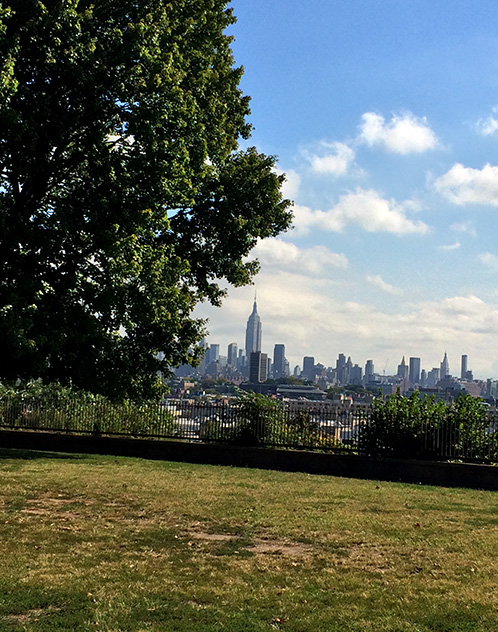
Here’s the first image taken with my iPhone 5S.  It’s a view of the Empire State Building in New York City and I am standing in Riverview Park.

Continue reading → On the Jersey City Heights Streets with the iPhone 5S Camera and Red Squares on Abandoned Buildings