 by
by The 2020 census counted two people in Monowi, Nebraska. The arithmetic surprised the only one of them. Elsie Eiler has lived alone in the village since her husband Rudy died in 2004. She is the mayor, the clerk, the treasurer, the librarian, and the keeper of the Monowi Tavern, the last business open in a town of 0.21 square miles on the far northern edge of the state. When the new census figures came out in August 2021 and showed Monowi’s population doubled, she gave the Lincoln Journal Star the only answer a competent count of one allows. “Well, then someone’s been hiding from me, and there’s nowhere to live but my house. But if you find out who he is, let me know?”
There was no second person. There was a number dressed as a person, and the Census Bureau put it there on purpose. A bureau spokeswoman explained the arrangement to the Journal Star, in terms plainer than federal agencies usually allow themselves. “What you’re seeing there is the noise we add to the data so you can’t figure out who is living there,” she said. “It protects the privacy of the respondent and the confidentiality of the data they provide.” The phantom had been shifted from some other census block, because the national total must stay true even when the local one is false. “We take the same number of people, but we move them around. When you look at it all the way out, it’s correct.” All the way out is a long way from Monowi.
The same arithmetic visited the Boyd County village of Gross, twenty miles northwest, and brought the opposite signature. Gross is home to Mike and Mary Finnegan, two people, a fact confirmed by every reporter who makes the drive. The 2020 census counted three. Somewhere between the Finnegans’ kitchen and the federal tabulators, Gross acquired a citizen it does not have. No one in Washington can say who he is supposed to be. He exists the way Monowi’s second resident exists, as noise with a mailing address.
Washington does not consider any of this an error. The method has a name, differential privacy, and it rests on the oldest promise in American statistics. Title 13 of the United States Code writes the guarantee flat. No officer or employee of the Census Bureau may “make any publication whereby the data furnished by any particular establishment or individual under this title can be identified.” Only sworn employees may examine an individual census form. The forms are immune from subpoena and sealed by law for seventy-two years, and a worker who leaks one faces federal prison. That is the whole architecture of trust.
This method earned its pedigree through failure. For decades the bureau protected small places by swapping households between blocks, a quiet shuffle meant to blur anyone unusual. Then the bureau’s own scientists tested the shuffle, and the shuffle collapsed.
Between 2016 and 2019, Census Bureau researchers ran an attack on their own 2010 census, working from nothing but the published tables. Using only 34 of those table sets, they rebuilt person-level records carrying five variables: census block, sex, age, race, and ethnicity. In 70 percent of the nation’s census blocks, home to 97 million people, every record came back a perfect match. The team then linked the rebuilt people to commercial marketing files of the sort anyone can buy and confirmed the identities of 52 million respondents, 17 percent of the country. Given source data as good as the bureau’s own, the attack confirmed 179 million, 58 percent. The bureau published all of it, in its own working paper and technical summaries on census.gov, and concluded the old protections could not stand.
Differential privacy is the answer the bureau chose. The system injects calibrated noise into the published tables, so the count of the nation stays exact while the count of Monowi becomes deliberately wrong. Skeptics in the demographics journals objected that a blind guess matches real people nearly as often as the bureau’s attack did. That holds in the aggregate. On a block of one it means nothing: a table recording a white woman born in 1933 and living alone in Monowi is an identification, whatever the lawyers call it. Alabama attacked from the other direction and sued in March 2021, arguing that noise-corrupted block data was unfit for redistricting. A three-judge federal court heard Alabama v. United States Department of Commerce and refused on June 29, 2021 to stop the bureau, and the case closed that September. The 2020 figures shipped with the noise inside them. Monowi’s phantom is the system working as designed.
That is one instrument. In the same decade, Washington sent a second instrument into Nebraska, 130 miles southwest, and this one tells the truth about everyone.
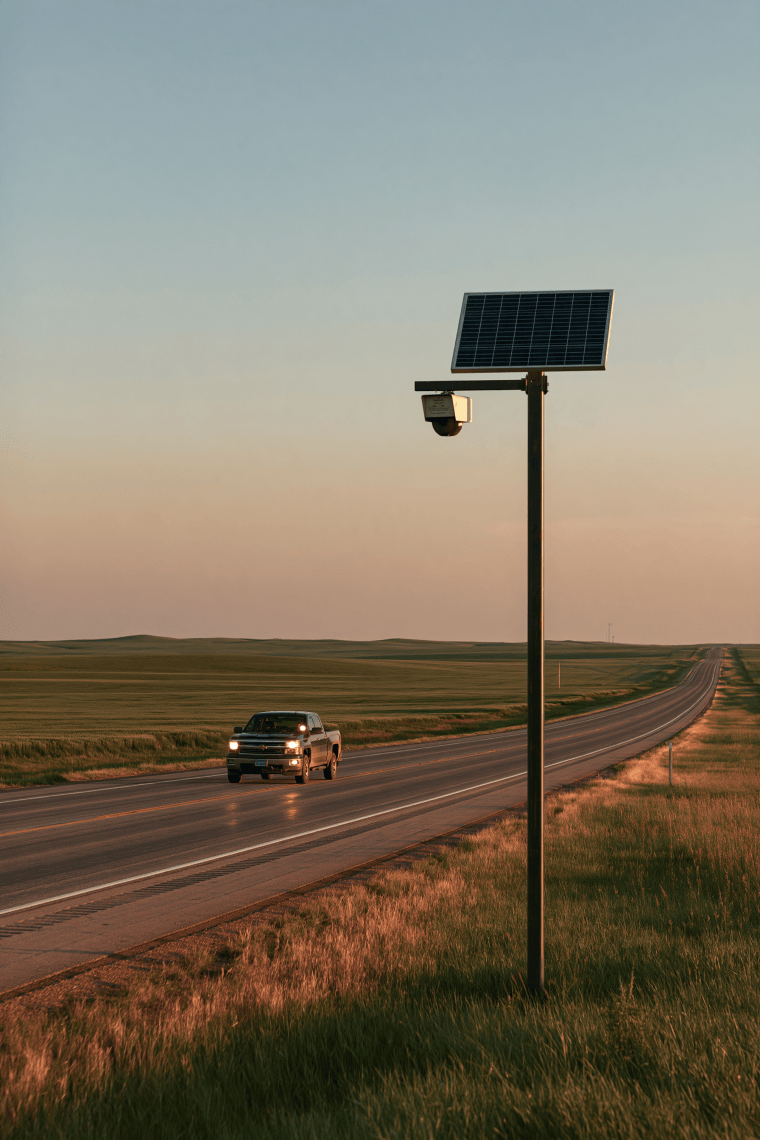
Ord is a farm town of 2,113 people by the same count. It is the seat of Valley County, set along State Highway 11 in the center of the state. In August 2025, Region 26, the emergency management agency serving Valley County and nineteen of its neighbors, signed a $49,000 grant with the Nebraska Emergency Management Agency. The money came from the Department of Homeland Security. It bought as many as fourteen license plate cameras from Flock Safety. The company’s network now spans some 120,000 cameras in more than 5,000 jurisdictions. Counties could raise a hand and receive one. Valley County raised its hand for two, and both of them went to Ord.
Sheriff David Scheideler took the cameras gladly. His office had covered the whole county since Ord’s police department collapsed to turnover in late 2024. “We were reaching a point where I needed more officers,” he told the Flatwater Free Press. “Our resources couldn’t provide the coverage we needed.” Region 26 pitched the cameras as a staffing supplement, and the first two were free. The Ord City Council approved the cameras in September 2025. Mayor Jeramy Sedlacek says the city was told they would help stop crime and would not store any information. The mayor’s later review of that pitch is on record. “I probably should have done my research a lot more,” he told the newspaper. “Information can be sold. It’s a third-party company that has the information.”
In February the cameras went up. One watches 14th Street where it meets State Highway 11. The other reads southbound traffic at the west edge of town. They photograph every passing car and read more than the plate: make, model, color, dents, bumper stickers, and how often a particular vehicle comes by. Christopher Bruha, an Ord native who drives past them twice a day, told 10/11 News what the lens takes from him. “Even if we were to hide the license plates and it couldn’t read the license plate, it is still finding valuable information to be able to create my whole profile.”
Valley County owns the cameras, a fact with teeth. Ord eventually rebuilt its police department, and its new chief, Branden Stoural, cannot look at what the cameras in his own town record. If he wants something from the Flock network, he requests the data from the county. “I think we’ve used it maybe a couple of times since I’ve been here,” he told 10/11. The department has run fewer than five searches in a year, and the system has yet to produce an arrest or a conviction for the city it watches. An instrument aimed at Ord does not answer to Ord.
The sheriff’s office can look, and so can nearly everyone else with a badge. County records obtained by the Flatwater Free Press show 61 local searches of the county’s Flock data in the month between July 19 and August 18. In that same month, the data surfaced in 450,646 searches run by nearly 3,000 law enforcement agencies, the FBI and the CIA among them. More than 200 of the searches concerned immigration, some tied directly to ICE. The newspaper is careful to note the figure does not mean those agencies were hunting Valley County drivers in particular; the network answers every query it is fed, wherever the query begins. The camera bolted above Highway 11 to catch local car thieves spends its days inside a national pool.
Nebraska law offers no backstop. The state’s Automatic License Plate Reader Act, passed in 2018, regulates who may see plate data and requires annual reporting, and it does not prohibit immigration searches or sharing with federal agencies. Matt Hansen, the former state senator who introduced the law, conceded to the Flatwater Free Press that immigration use “just wasn’t anything we thought of at the time.”
Flock’s own documents describe the terms of that pool. The company held a thirty-day default retention period for years. In August 2026, after a year of scandals, it cut its recommended default to seven days and added a preservation mode for active cases. Every search is logged. Sharing is described as a local decision, which is true the way each bulb on a string of lights is locally wired. A federal court, the Flatwater Free Press reported, has found that the retention clock governs only the copy in the company’s cloud; data downloaded out of the system, through a public records request, can be kept indefinitely. Deletion, in the surveillance economy, is a promise about one copy among many.
What the pool can carry surfaced in May 2025, in Texas. On May 9, an official with the Johnson County Sheriff’s Office logged into Flock’s national lookup and typed the reason for the search into the required field: “had an abortion, search for female.” The first pass covered 1,295 networks and 17,684 cameras going back a week. The second, the one 404 Media exposed later that month, reached 6,809 networks and 83,345 cameras and a full month of the country’s driving. Its reach included cameras in Washington and Illinois, states where the act being hunted is a legal right.
Sheriff Adam King told reporters the search was a welfare check. “Her family was worried that she was going to bleed to death, and we were trying to find her to get her to a hospital,” he said. Records later obtained by the Electronic Frontier Foundation describe a different event: a death investigation of a non-viable fetus, with evidence of a self-managed abortion collected from the woman’s partner. Detectives asked prosecutors about charging her. The district attorney’s office answered that the State could not statutorily charge her for taking the pill. She was never charged. The investigation stayed open for weeks. King has since been indicted on unrelated felony counts, and separately charged with aggravated perjury for allegedly lying to a grand jury. By August, two members of Congress had opened a formal investigation into Flock’s role. Flock Safety called the original reporting false and clickbait. Its chief executive, Garrett Langley, told Forbes, “this is everything’s working as it should be.”
The true part of all of this is real. The cameras solve crimes. Sheriff Scheideler credits them with six felony arrests and says replacing them would mean hiring two deputies his county cannot afford. Federal courts have ruled again and again that a license plate on a public road carries no constitutional privacy right, a point Flock’s representative, Phillip Arnold, carried to the Valley County crowd in August. “There is no right to privacy on a public roadway.” The census noise earns its keep as well: no one will ever read Elsie Eiler out of a federal table. Both instruments perform exactly as advertised.
Nebraska’s ledger for the decade has two entries. The Department of Commerce counted Elsie Eiler and invented her a neighbor to keep her secrets. The Department of Homeland Security paid for the cameras over Highway 11, and those cameras swear no oath and keep no secrets for the people they record. One instrument invents a person to protect a person. The other records every person to protect no one in particular. The honest instrument is the one that lies.
What divides them is consent. Eiler answered the census because the law asked. The same law swears, with prison attached, that her answers will never point back at her. The camera asks nothing and swears nothing. It arrived as a grant and a pitch. The pitch was that the cameras would store no information, and it was false the day it was delivered. Jared Zulkoski, the Ord City Council president and the lone vote against the cameras when they came, named the missing piece for 10/11. A phone app at least shows you a little button that says I acknowledge. “But driving down the public highways, you have no idea who’s looking at it, what they’re doing with the information, so it’s kind of an eerie feeling.”
Ord answered the eerie feeling on August 3. The council voted 5 to 0 to remove both cameras, the first city in Nebraska to reject them outright. A week later the Valley County board room was standing room only. The residents who packed it heard the county agree to pull the two cameras in town and keep the seven outside it. “We didn’t get a say in these cameras coming here,” one member of the public told the supervisors. So they took the say. Sheriff Scheideler, who still wants the cameras, made the county a promise of his own. “If this is ever litigated in Nebraska or the Supreme Court, and it comes down to these things are violating your civil rights, they’re gone. They’re gone.”
Monowi and Gross never got a vote on their phantom neighbors. They do not need one. The law that invented the phantoms is the same law that guards the kitchen-table answers of a third of a billion people. Those phantoms are the price of a promise, published in the open where everyone can see the seams. The cameras reversed every term of that arrangement. They were bought with federal money, owned by a county, fed into a national system, and aimed at a town whose own police chief has to place a request to learn what they saw.
Back in Monowi, the paperwork of one resident runs its annual circuit. Each year the liquor license for the Monowi Tavern comes up for renewal, and it passes through the same pair of hands at every step. Eiler applies as the owner of the tavern. The application goes to the village, where she receives it as secretary and signs it as clerk. The approval comes back across the counter to the woman who asked for it, granted by the board she embodies. Guinness World Records keeps the arrangement on file because there is nowhere else in America to file it. A whole jurisdiction folds into one resident: applicant, clerk, and authority, the same woman on both sides of the counter.
The census decided that woman needed a second person. It built one out of arithmetic and set it beside her name. The cameras look at everyone and decide nothing. Deciding belongs to whoever holds the password, in Valley County or Washington or a sheriff’s office in Texas. On the wall of the tavern hangs the license with her name in every blank. On the green sign at the edge of town the number still reads 1. She is the only jurisdiction in America where surveillance and consent are the same woman.
@boles
They’ll have to rename it Duowi
Remote Reply
Original Comment URL
Your Profile
Why do I need to enter my profile?
This site is part of the ⁂ open social web, a network of interconnected social platforms (like Mastodon, Pixelfed, Friendica, and others). Unlike centralized social media, your account lives on a platform of your choice, and you can interact with people across different platforms.
By entering your profile, we can send you to your account where you can complete this action.
You win the best comment of the day!