Page 4 of 27

Arm in Arm with Chance

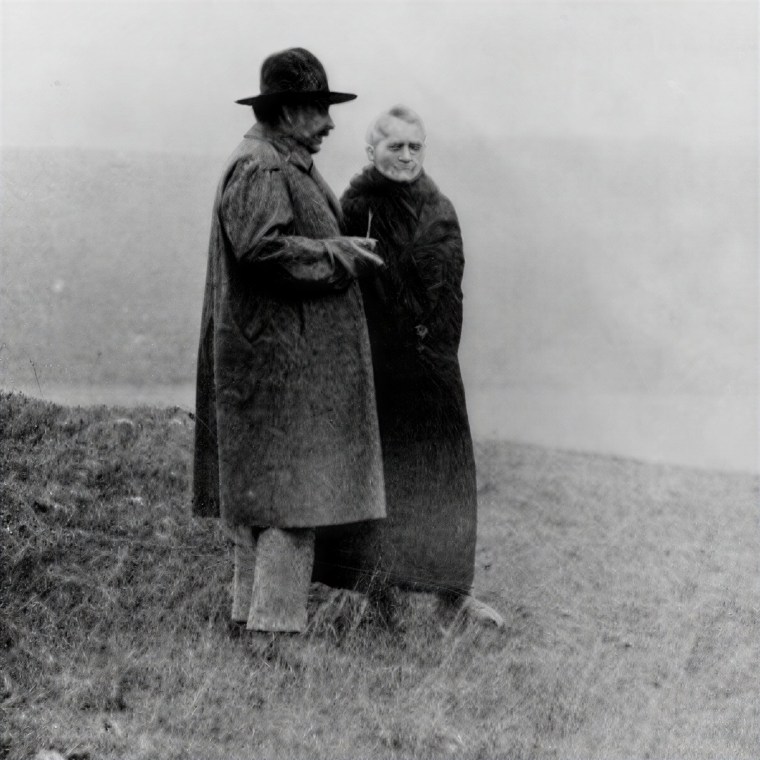
A misdated photograph, two of the largest minds of the last century, and the partnership physics never got. The photograph travels well. A man and a woman walk the edge of a lake, both buttoned into heavy coats against a cold the season should not have brought. He wears the famous hair, gray now at the temples, the drooping mustache, the look of someone who long ago stopped negotiating with his tailor. She is smaller and upright, her face composed into the expression of a person who has weighed sorrow by the gram. Their arms are linked. The internet, which prefers its history pre-chewed, captions the image with confident precision: Albert Einstein and Marie Curie, Saranac Lake, New York, 1929. Nearly every word of that caption is wrong.
Continue reading → Arm in Arm with Chance

What the Lemmings Could Not Do: On Suicide, Cognition, and the Mortal Imagination

Of all the acts a human being can perform, suicide is the strangest. It requires the actor to picture a world without itself, judge that world preferable, and execute a plan whose author will not survive to see the result. No other behavior in the human repertoire so cleanly inverts the survival logic that built every body and every brain. The question of whether other animals do the same thing is a question about cognition. The behavior is downstream of cognition, and beneath cognition runs the question of meaning. To kill oneself one must first have the kind of self that can be killed by its owner.

Continue reading → What the Lemmings Could Not Do: On Suicide, Cognition, and the Mortal Imagination

Hands as the Language of Thought: Correcting a Kant Attribution

There is a line about hands that travels well. It reads cleanly, carries an air of philosophical dignity, and arrives in print wearing the name of Immanuel Kant. “The hand is the visible part of the brain,” runs the most common English form, or, in an older rendering, “the hand is the outer brain of man.” The phrase appears in publishing copy, in teaching materials, on Goodreads quotation pages, in popular psychology, in surgical textbooks, in neurology lectures, and in essays on sign language and gesture. It has the shape of something Kant should have said. The difficulty is that no reliable evidence supports treating it as a verified Kant statement.

Continue reading → Hands as the Language of Thought: Correcting a Kant Attribution

The Charge and the Curriculum: How the Dark Arts Replaced Black Magic

Two phrases arrive from different centuries and now sit on the same shelf: “black magic” and “the Dark Arts.” Modern speakers treat them as synonyms. Older readers would have disagreed, and the disagreement matters, because the collapse of the two terms shows how our language for forbidden knowledge has migrated from the judicial to the aesthetic, from accusation to ambience.

Continue reading → The Charge and the Curriculum: How the Dark Arts Replaced Black Magic

Sontag’s Two Doors, Campbell’s Underworld

In a television interview that has circulated for years, Susan Sontag offers a small theory of storytelling. She points out that the English word “story” carries a double valence. We say “tell me the real story” to demand truth, and we say “that’s only a story” to dismiss invention. Stories, she argues, face two directions at once, toward fact and toward fantasy, and this doubleness sits at the center of what stories do.

Continue reading → Sontag’s Two Doors, Campbell’s Underworld

The Area Code Comes Home

When Scott Frost took over at Nebraska in 2018, he brought with him from UCF a small equipment decision that ran directly against what the phone system had been doing for fifteen years. Frost let Husker players wear their three-digit home area code on the helmet bumper above the face mask. A Peyton Newell on the defensive line, a Mike Williams at wide receiver, an Andre Hunt lining up outside, each wore the digits of where they came from in black on red. The helmet bumper is a small piece of real estate, two inches by four, just large enough to carry three numbers. Frost had started the practice at UCF in late 2016 before the USF rivalry game, and he said at Nebraska that the guys took a lot of pride in it. Where you come from, he said, still counts.

Continue reading → The Area Code Comes Home

Seeing Around Corners

The phrase “seeing around corners” gets tossed around boardrooms and strategy meetings as though it were a compliment, a kind of secular beatification for the executive or thinker who got there first. But the phrase deserves closer scrutiny, because what it actually describes is a discipline, and one that most people refuse to practice because the conclusions it produces are uncomfortable.

Continue reading → Seeing Around Corners