 by
by A misdated photograph, two of the largest minds of the last century, and the partnership physics never got. The photograph travels well. A man and a woman walk the edge of a lake, both buttoned into heavy coats against a cold the season should not have brought. He wears the famous hair, gray now at the temples, the drooping mustache, the look of someone who long ago stopped negotiating with his tailor. She is smaller and upright, her face composed into the expression of a person who has weighed sorrow by the gram. Their arms are linked. The internet, which prefers its history pre-chewed, captions the image with confident precision: Albert Einstein and Marie Curie, Saranac Lake, New York, 1929. Nearly every word of that caption is wrong.
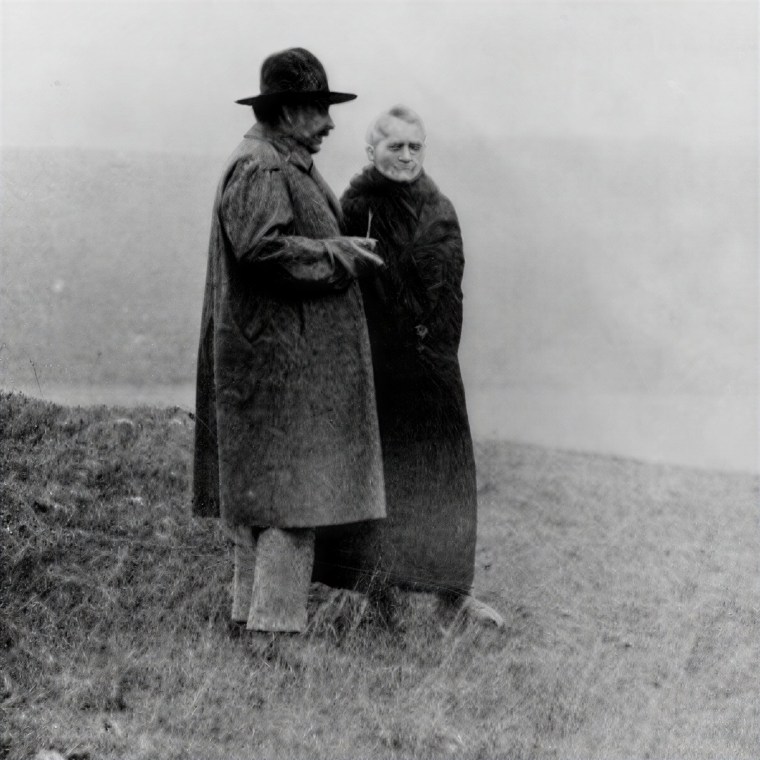
Start with the simplest error. The two never met on American soil. Einstein did come to love sailing on Saranac, yet he first laid eyes on that water in 1936, two years after Curie was in her grave. The file name on the most-shared copy reads 1923, also incorrect. The Musée Curie in Paris, the French National Library, and UNESCO’s own journal each labeled the picture 1925. When a Polish researcher named Jakub Müller decided the question deserved an answer rather than a guess, he spent the better part of three years on it, and the American Institute of Physics published his findings in 2023. He matched the dates of the League of Nations intellectual-cooperation meetings the two attended together, read Einstein’s travel correspondence in the Hebrew University archive in Jerusalem, pulled Geneva weather reports and checked them against the daily papers to explain those out-of-season coats, and then did the obvious thing he could have done first. He asked the Musée Curie whether anyone had written on the back of the family copy. Irène, Marie’s elder daughter, had. She dated it July 1924, and she placed it on the shore of Lake Geneva.
So the lake was Swiss, the year was a half-decade off, and the cold that put them in winter coats in July was Lake Geneva being itself. One dissent survives, worth naming because honesty costs nothing here. Helen Dukas, who served as Einstein’s secretary for more than twenty years, guessed in a 1979 letter that the picture came from Paris in November of 1929. She remembered the coat. She offered no other evidence, and she was eighty-three. Whether you side with Irène’s pencil or with Dukas’s memory, the American story falls apart. The lake was in Europe. The two people in the coats had been friends for nearly twenty years.
Why does the wrong caption hold so firmly when the right one is a search away? Because the false version is the better product. “Saranac Lake, 1929” hands the scroller a tidy myth: two titans, one chance meeting, an American postcard. The truth, that this was one walk among many across two decades of letters and shared committees, asks for attention the feed will not spend. A meme is a story stripped down until it can replicate, and accuracy is usually the first weight thrown overboard. The image keeps mutating because the caption keeps lying, and the lie keeps winning because it feels like it ought to be true. That is a small lesson about how we treat our dead geniuses. We would rather keep the postcard than open the archive.
So take the lie at its word for a moment. The photograph belongs to 1924, and on that Geneva shore Einstein was forty-five and Curie fifty-six, both in Switzerland for the same League committee that had put them arm in arm. The meme insists on 1929, and 1929 turns out to be the year that shows us the most, because within a few years of it one of them would be driven out of his country and the other would be dead. Take the wrong date, then, as the right lens, and ask where these two stood in it, and what it would have meant if the friendship in that coat-bundled walk had ever hardened into a working partnership.

In 1929 Albert Einstein turned fifty, and he spent his birthday hiding. A few months earlier he had published a paper on what he called a unified field theory, an attempt to fold gravity and electromagnetism into one mathematical structure by way of a geometry called distant parallelism. The press, which understood none of it, treated the equations as front-page revelation, and reporters laid siege to his Berlin apartment. So on the morning of March 14 he slipped away to a gardener’s cottage on the Havel owned by a gossipy society doctor, cooked his own meals, and let the newspapers speculate about where he had gone. That same year the city of Berlin tried to give him a lakeside plot of land as a birthday gift, and the right-wing nationalists in the city assembly turned the gesture into a brawl, objecting so loudly that Einstein declined the present and bought his own parcel instead, a wooded rise above Lake Templin near the village of Caputh. A young architect built him a modern wooden house there. He kept a sailboat moored minutes away. For four summers it was the place he loved most on earth, and at the end of 1932 he would leave it, and Germany, and never come back. The men who fought over his birthday gift were a small rehearsal for the ones who would soon make a Jewish physicist’s life in Berlin impossible.
While Einstein hid from his own fame by one lake, Curie was crossing the Atlantic toward a different reckoning. She arrived in New York in late October of 1929 on her second American tour, organized, like her first, by the journalist Missy Meloney. The purpose was money. Poland had become a republic again in 1918, and Curie wanted a radium institute in Warsaw, the city of her birth, but radium cost a fortune and her laboratories never had enough of it. She reached Washington two days after the stock market collapsed into what would become the Great Depression, and in a capital suddenly staring at its own ruin, President Hoover still received her at the White House, where she stayed as his guest, a privilege extended to no foreigner before her. He handed her a bank draft for fifty thousand dollars. The figure carries its own quiet story. Eight years earlier a single gram of radium had cost a hundred thousand, and the price had since been cut in half by cheap commercial radium dug out of the Belgian Congo. She was sixty-one. Her hands were cracked and scarred from four decades of handling the element she had named, her eyes were clouding with cataracts, and the aplastic anemia that would kill her in 1934 was already at work, the slow interest charged on a lifetime spent with her bare fingers in radioactive light.
Two lakes, two continents, one autumn. He was fleeing the attention she was working to convert into laboratory funding. He wanted a cosmos that held together; she was being taken apart, cell by cell, by the substance that had made her immortal. And here is the irony the wrong caption never suspected, the one that would have made their lakeside walk worth overhearing.
By 1929 Einstein had set himself against the strangest claim of the new quantum physics, the idea that nature, at its smallest scale, runs on chance. A few years before, in a letter to Max Born, he had put it in the line that trailed him for the rest of his life, his conviction that God does not play dice with the universe. He wanted a world that was, in principle, fully determined, every effect chained to its cause, the apparent randomness of the quantum a mark only of our ignorance. He hunted the theory that would prove it for thirty years, and he died without it.
Now consider the woman on his arm. Marie Curie had built her entire life on a process that is random in exactly the way Einstein could not accept. Radioactive decay cannot be predicted for any single atom. No one can say which nucleus will break apart, or when. We can state only the odds, the half-life, the behavior of billions averaged together. Those glowing tubes of radium in her Paris laboratory were chance made visible, a working demonstration of the dice Einstein swore the universe would never throw. The friend beside him had spent her career measuring the indeterminacy he could not stomach. Their most famous photograph is, without either of them intending it, a snapshot of the deepest quarrel in twentieth-century physics: the man who demanded certainty, walking arm in arm with the discoverer whose radium kept answering, again and again, with chance.
What might they have said to each other on that shore? Not equations. By 1924, and still in 1929, the distance between them ran deeper than affection could close. He worked with a pencil and a vision of unity, raising cathedrals of geometry in his head. She worked with pitchblende and electrometers and her own ruined hands, and she trusted nothing she had not measured twice. I imagine her telling him, in that flat Polish-accented French, that his beautiful unified theory had not yet survived a single experiment, and that until it did it was philosophy wearing the costume of physics. I imagine him conceding the point with a laugh and refusing to change course, because he had already decided a theory could be too elegant to be wrong. They had played this scene before. On a mountain trail in the Engadine in the summer of 1913, their children and a governess strung out along the path behind them, Einstein walked beside her so far inside the problem of gravitation that he barely saw the Alps, and afterward, writing to his cousin Elsa, he called Curie brilliant but cold, a woman with the soul of a herring, by which he meant she surrendered nothing of joy or grief. He misread her. The reserve he took for coldness was the armor of a woman who had buried her husband under the wheels of a horse-drawn cart in a Paris street in 1906, and then, five years later, watched the French press try to ruin her for loving another man.
He, of all people, should have understood, because he had stood near it. In November of 1911, while Parisian papers printed Curie’s stolen love letters and a crowd gathered outside her house to frighten her two young daughters, Einstein wrote to her. He told her not to laugh at him for writing with nothing sensible to say, admitted he was enraged by the way the public dared to concern itself with her, and dismissed the scandalmongers as reptiles feeding on hogwash she should refuse to read. Then, almost in the same breath, in the same letter, he told her about a physics problem he had just solved. That is the true texture of what they shared. Comfort and shop talk in one envelope, moral solidarity folded into a note on the statistical behavior of molecules. They were two people who had each learned, separately and at cost, that the world will turn a private life into public sport, and that the only answer is the work.
So if the walk by the lake was friendship rather than collaboration, what would a real collaboration have produced, and why did it never come? The honest answer is that almost everything in their world was built to prevent it. Their methods did not meet, the theorist and the experimentalist aimed at different horizons. Their cities did not meet either, since Berlin and Paris, in the decade after a war that had set German and French science at each other’s throats, made no easy commute for a German Jew and a Polish Frenchwoman. The age itself refused to permit it. Curie had been refused membership in the French Academy of Sciences in 1911, narrowly and pointedly, because she was a woman and a foreigner, and any paper carrying both their names would have been read across the world as Einstein’s discovery with Madame Curie’s help, her two Nobel Prizes counting for nothing against the assumption. The radium was killing her on a clock no partnership could outrun. The politics were about to scatter them, him to America, her to an early grave.
They did collaborate, in the one arena left open to them, and the result instructs us. Both sat on the League of Nations committee for intellectual cooperation, the nearest thing the 1920s built to an international republic of the mind. Curie believed in it. She gave it years, served as its vice president, and held her seat until near her death. Einstein lost faith in it. He watched the League prove helpless against the nationalism rising on every side, and in 1932 he resigned in disgust, a year before Hitler took the country he was fleeing. That split is the truest measure of the two of them. She kept faith with the institution and worked it from the inside until her body failed. He judged the institution a fraud and walked away to save his strength for the equations and the exile ahead. Put these two on a committee and you do not get a unified theory. You get two opposite verdicts on whether the world can be saved by decent people sitting in a room.
That is the partnership we lost, and it is worth being clear-eyed about how small the loss may have been, because sentimentality wants us to believe that genius plus genius equals revelation. It rarely does. Einstein’s unified field theory failed because the cosmos was not built the way he wished it to be, and a brilliant partner would have changed nothing about that. Curie’s hard empiricism, married to his soaring vision, would more likely have produced friction than fusion. When we look at that misdated photograph, the ache has nothing to do with equations they never wrote together. We are watching two people who paid, in privacy and in flesh, the full price of seeing further than anyone near them, stealing a few minutes by a cold lake to be, for once, simply understood by someone who had paid the same.
The caption gets the lake wrong, and the year, and the country. What it gets right is the longing underneath, the wish that the two of them had been handed more than a walk. They were not. He sailed his boat at Caputh until the men who hated him made even that impossible. She carried her fifty thousand dollars to Warsaw, built her institute, and died with radium in her bones. The lake in the photograph was never the one the caption claims. The collaboration the photograph seems to promise was never real at all. And still the image travels, mislabeled and beloved, because some part of us cannot accept that the two great minds of the age were granted only friendship, a handful of committee meetings, and one good letter written in defense of a woman the world was trying to destroy. We keep captioning it Saranac, America, 1929, the place and year of a meeting that never happened, because the real story, two giants who deserved a partnership and were handed a snapshot instead, is the harder thing to look at.