Page 3 of 5

Writing Letters to a Dead Man: Dr. Howard Stein in Memoriam

Yesterday, I received the one phone call I’d been dreading for over 30 years: “Howard Stein is dead.”  It turns out Howard died back on October 14, 2012 after an eight-day hospitalization, but I didn’t learn of his death until yesterday.   I knew he was deathly ill the last year, and when his surgeon recently refused to do a final operation, Howard told me his heart had finally turned against him and become a “ticking time bomb.”

As I paged back through my calendar for the last six weeks to memorialize the final events of my life with Howard, I reflected back on our final telephone conversation on October 1, 2012.  He told me how much he appreciated the letter I wrote celebrating his 90th birthday.  He said he read the letter every day.  That meant a lot to me.  He was my master.

One the first day of October, Howard and I left it that Janna and I would visit him in Stamford, and that he would check his doctor schedule and call me back to let us know what day would work best.

I never heard from him again.

A week later he was in the hospital — never to see the sky again.

As you can see in the graphic below, I tried to call him on October 5th and 11th to check on our visit date.  There was nobody home when I called.  On October 22 and November 13 I wrote him letters — our one, ancient, guaranteed way of always getting in touch when time and tide and humanity and the phones failed us — to inquire about the visit.

I had no idea was writing to a dead man.

Now I know how Bartleby really felt working in the Dead Letter Office.
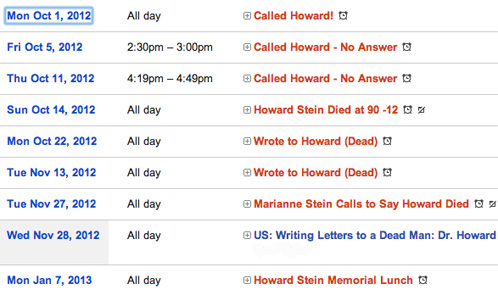
Continue reading → Writing Letters to a Dead Man: Dr. Howard Stein in Memoriam

The Strong are Saying Nothing

Robert Frost is one of our greatest American minds — and the delivery method for sharing his genius was the poem.  On November 17, 2005, I wrote — Humility in Adoration — for Urban Semiotic, where I described the moment Mark Van Doren introduced Robert Frost to adoring fans at Columbia University in the City of New York:

The lesson of Coriolanus was echoed decades later by the genius American poet Robert Frost in 1950 when he was accepting an award at Columbia University. Frost whispered to his good friend — and fellow genius — Columbia Faculty member Mark Van Doren, that he didn’t think he deserved the award he was getting, but he felt it would be rude to go against the will of the people who wanted to honor and admire him.

Van Doren smiled, agreed, and introduced the great poet to a Columbia crowd who provided a thunderous standing ovation for Robert Frost. Mark Van Doren used that private discussion with Robert Frost to explain Coriolanus’ downfall in human terms his Shakespeare literary students could understand. The learning we must curry from Coriolanus and Robert Frost and Mark Van Doren is how we must all willingly accept praise and compliments from others without questioning intent or assuming there is a hidden purpose behind the kindness.

Continue reading → The Strong are Saying Nothing

Eben Moglen and his Facebook Death Wish

Our beloved and respected Eben Moglen is back in the news this week.  We met Eban a year ago during his FreedomBox days:

SuperGenius Eben Moglen wants free and unfettered access to the internet and he’s putting his money where his mind is by creating the “FreedomBox” — a device that plugs into the wall and gives you unfettered and unrestricted access to the internet — to help make certain that a government cannot disconnect its people from communicating with the rest of the world during a perceived crisis.


Continue reading → Eben Moglen and his Facebook Death Wish

Yes, You Can End a Sentence with a Preposition: Appropriate Grammar is Not Absolute

I recently had a wonderful conversation with my mentor Howard Stein — also my Columbia University MFA Playwriting Chair and head of the Oscar Hammerstein II Center for Theatre Studies, and now lifelong friend — concerning the appropriateness of ending an English sentence with a preposition.

Continue reading → Yes, You Can End a Sentence with a Preposition: Appropriate Grammar is Not Absolute

Did the Business School Ruin the University?

Society is materialistic.  The university used to be a safe haven where ideas mattered and thoughts were given greater standing than finding ways to make more money.  Peter Thiel believes higher education is a bubble ready for the bursting — but you can only agree with Thiel’s thesis if you also believe students attend university to get a job.  I don’t happen to purchase his premise.  I believe students should attend university in order to learn what they do not know.

Continue reading → Did the Business School Ruin the University?

When Did the Playwright Decide His Own Life Was Worth Examining in a Play?

When did the Playwright turn away from others as a topic of his plays and turn into himself to become the Autobiographer of his own wishes, dreams and experiences on stage? The Amazing Howard Stein and I recently shared a conversation on this topic and Howard wondered if the first instance could be found in Aeschylus who wrote “The Persians” in 472 BC.

Continue reading → When Did the Playwright Decide His Own Life Was Worth Examining in a Play?

The Disgrace of Unpaid Interns at For-Profit Companies

If you have been to college in the last 2o years, an internship was likely part of your valuable learning process.  Interns must be paid at for-profit companies — either by the company or the school — or else one risks abusing volunteer student work as slave labor.

Continue reading → The Disgrace of Unpaid Interns at For-Profit Companies