Page 2 of 7

Figure Eights

The internet has decided that modern humans are developing zoochosis, the madness of caged animals. The claim is older than TikTok, and the truth underneath it is more uncomfortable than either the believers or the scoffers want it to be. For most of the 1990s, the most famous resident of the Central Park Zoo was a 700-pound polar bear named Gus who spent up to twelve hours a day swimming the same figure eight through the same small pool. Back and forth. The same loop, traced into the water until it wore a groove in the day. Reporters called him neurotic, depressed, flaky, and bipolar, and New Yorkers half-adopted him as a mascot for their own condition. In 1994 the zoo paid an animal behaviorist twenty-five thousand dollars to find out what was wrong, and the verdict passed into legend. Gus, the behaviorist said, was bored and mildly crazy in the way that a lot of people in New York are. The zoo redesigned his habitat, hid his food inside blocks of ice, gave him toys, and made him the first zoo animal in recorded history to be put on Prozac. The swimming eased. It never fully stopped. Until the day he died in 2013, there were afternoons when Gus would throw himself back into the water and trace the loop again, and again, and again.

Continue reading → Figure Eights

The Ball of Violence: Joe Kenda and the Killer Inside All of Us

Joe Kenda says extreme violence lives in everyone’s DNA, waiting for emotion to overrule judgment. My friend is a great detective and a shaky geneticist, and the difference matters. Janna and I have known Lt. Joe Kenda the way friendships form now, across screens and wires, built from years of mutual attention. It began when he found this blog more than a decade ago and, in the phrase that gave an old post its title, stayed followed. He has sent us gifts. He is, in the way that counts, a generous man, courteous to strangers who admire his work and himself in a business that rewards performance. So when he stood at CrimeCon and told a room full of true-crime devotees that every person in it carried a ball of violence encoded in their genes, I listened closely. Then I did the thing you owe a friend whose mind you respect. I checked whether it was true.

Continue reading → The Ball of Violence: Joe Kenda and the Killer Inside All of Us

Arm in Arm with Chance

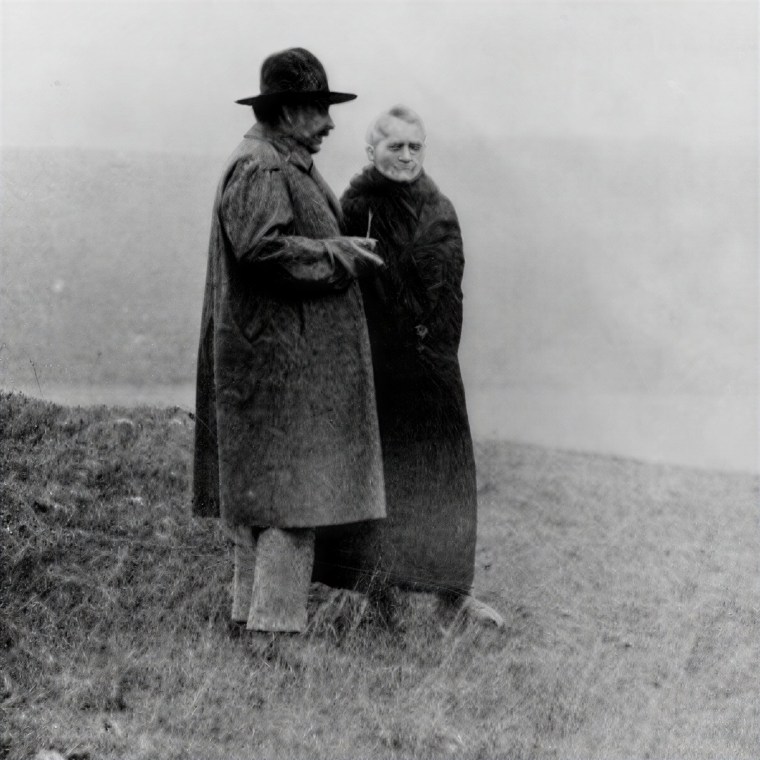
A misdated photograph, two of the largest minds of the last century, and the partnership physics never got. The photograph travels well. A man and a woman walk the edge of a lake, both buttoned into heavy coats against a cold the season should not have brought. He wears the famous hair, gray now at the temples, the drooping mustache, the look of someone who long ago stopped negotiating with his tailor. She is smaller and upright, her face composed into the expression of a person who has weighed sorrow by the gram. Their arms are linked. The internet, which prefers its history pre-chewed, captions the image with confident precision: Albert Einstein and Marie Curie, Saranac Lake, New York, 1929. Nearly every word of that caption is wrong.

Continue reading → Arm in Arm with Chance

What the Lemmings Could Not Do: On Suicide, Cognition, and the Mortal Imagination

Of all the acts a human being can perform, suicide is the strangest. It requires the actor to picture a world without itself, judge that world preferable, and execute a plan whose author will not survive to see the result. No other behavior in the human repertoire so cleanly inverts the survival logic that built every body and every brain. The question of whether other animals do the same thing is a question about cognition. The behavior is downstream of cognition, and beneath cognition runs the question of meaning. To kill oneself one must first have the kind of self that can be killed by its owner.

Continue reading → What the Lemmings Could Not Do: On Suicide, Cognition, and the Mortal Imagination

The Vacuum Where the Evidence Should Be

Zach Bush, a physician in good standing, sits across from an interviewer and describes the soul, calm and fluent, generous with wonder. He says that every millionth of a second the atoms of your body dissolve and return, that a single fertilized cell organizes itself into a child by reading a map no biologist can locate, and that the map lives in the vacuum, in the electromagnetic field that fills the empty space inside every atom. He calls this the anatomy of the soul. In a 2021 essay on his own website he writes that the body projects itself as a hologram, and that its apparent solidity is an impression made by light. The performance is seductive because the vocabulary is real. Differentiation, migration, electromagnetic field, vacuum: each of those words has a home in a textbook. The trouble begins the moment you check whether they are being used the way the textbooks use them, or whether they have been borrowed to dress an idea that biology and physics both reject.

Continue reading → The Vacuum Where the Evidence Should Be

The Glass People: The Materials of Madness, from the Glass King to the Simulation

More than six hundred years ago, the King of France stopped letting anyone touch him. Charles VI had iron rods sewn into his clothing and moved through his palace with the stiff care of a man carrying something breakable, because he believed he was carrying something breakable. He believed it was himself. The chronicles of his reign record that the king became convinced his body had turned to glass, and that a careless embrace or an ordinary stumble would shatter him to pieces on the stone floor.

Continue reading → The Glass People: The Materials of Madness, from the Glass King to the Simulation

Reading the Lattice Without the Legend: Grinberg, Syntergy, and the Argument for Real Entry

A scientist walks out of his office in Mexico City on December 8, 1994, and never walks back in. The man is Jacobo Grinberg-Zylberbaum, forty-eight years old, a UNAM-trained neurophysiologist with a doctorate from New York Medical College, the author of a stack of monographs on consciousness, and the last serious researcher to claim that the human brain could be wired into a holographic substrate of reality he called the Lattice. He had spent years measuring electroencephalographic correlations between separated human subjects. Two months before he vanished, he published a paper in Physics Essays arguing that pairs of subjects, separated inside semisilent Faraday chambers fourteen and a half meters apart, showed brain activity that mirrored stimulation given to only one of them. Then he was gone. The laboratory was found. Several notes were missing. His wife, who had cause to suspect him of an affair and a documented history of violence, became a person of interest and was never charged. Mexican press cycled through the story for years. Mystics and conspiracy theorists folded the disappearance into the theory, as if the man had stepped sideways into his own hypothesis.

Continue reading → Reading the Lattice Without the Legend: Grinberg, Syntergy, and the Argument for Real Entry